
My Travel Budget Backpacking Solo in South America for 9 Months

Feeling a little overwhelmed planning your travel budget and route to South America?
If there's ever a decision I'm glad I made, it's to travel solo across South America. In 9 months I lived one dream and one epic adventure.
I had no idea how to budget. I noted down every expense from 10 peso caramelos (sweets in Argentina) to a $1000 trek, keeping an eye on my travel budget.
I stayed in a $4 dorm room in Huaraz to a dorm room in Patagonia that cost more than $100 a night, averaging around 50/50 between staying in shared rooms and private accommodation.
I spent my evenings in Argentina making Asado on a grill, devouring street food in Cartagena, sharing wonderful meals with friends I had met on the road and packing a healthy stock of granola bars and sandwiches for long hikes.
I splashed out on treks in Patagonia, skipped a couple of multi-day hikes in Colombia that didn't seem value for money. I night bused it through freezing borders between Bolivia and Argentina, cycled through the burning heat of the Atacama desert, trekked over the glaciers of Patagonia, slept under the stars of Tayrona National Park and cartwheeled over rainbow mountains.
The days were long and the months went by so quickly!
Here's how I spent my travel budget, backpacking 9 months around South America.
NB: This post isn't the 'perfect route'. It's more from someone who feared solo travel in South America and totally winged it. There are definitely parts that could have been thought out more or done better. But everything seemed to fall in place perfectly for me on my own personal journey. And that's what travel is all about! Your journey in your own unique way.
South America travel budget for 9 months

My fave trek ever!
To help track expenses on the road, I used a free app called Trip Coin. It was great for being able to input my total budget, convert local currency into GBP, track my average daily expenditure as well as my total. I also categorized everything so I knew exactly how much I was spending on accommodation in dorms/privates to excursions and food.
The total breakdown of my travel budget in South America
| Category | Total Spend (GBP) | Notes |
|---|---|---|
| Travel | £2,690 | Includes travel insurance, one-way flights to and from South America, and domestic flights and long-distance travel. |
| Private Accommodation | £2,179 | Private rooms, Airbnbs and apartments. |
| Activities | £1,757 | Treks, tours and excursions. |
| Dorm Accommodation | £1,200 | Hostel dorm beds throughout South America. |
| Eating Out | £1,043 | Restaurants, cafés, street food and social meals. |
| Local Transportation | £835 | Local buses, taxis, colectivos and night buses. |
| Groceries | £487 | Self-catering and supermarket shopping. |
| Coffee & Snacks | £281 | Those little £1-2 purchases really do add up over time! |
| Other Expenses | £268 | Posting items home, border fees, backpack repairs, public toilets and other random things. |
| Toiletries | £143 | Toiletries and personal care items. |
| Education | £111 | Spanish lessons. |
| Clothing & Footwear | £100 | Replacement clothing and hiking gear. |
| Cash Machine Fees | £77 | ATM withdrawal fees across South America. |
| Mobile Phone / SIM | £64 | Local SIM cards and phone expenses. |
| Laundry | £62 | Laundry services during long-term travel. |
| Water | £51 | Bottled water purchases. |
| Health | £15 | Medication and minor health expenses. |
| Total | £11,363 | Approx. US $14,690 at the time of travel. |
Average daily spend: £43/day (approximately US $55/day).
Updated for 2026: I've kept my original budget breakdown because I think it's an interesting snapshot of what long-term travel cost me at the time. Prices have changed significantly since then. I've kept many of my original experiences and observations because they're an important part of my journey, while updating the practical information to reflect how travelling has changed.

Palccoyo rainbow mountain
Main culprits for high expenditure:
W-Trek in Patagonia. I hadn't planned on doing such an expensive trek but it was too good of an opportunity to miss last minute. Taking out this expensive trek, my costs fall to GBP £40/ US $51 a day.
Private accommodation when I first landed in Buenos Aires. It took me a few days to adjust and get used to finding good hostels (I stayed in some bad ones!).
Trying to find a low-cost flight from Buenos Aires to Colombia, to be honest, I could have flown back to London for the same price. I found it cheaper to fly from Uruguay. But it still set me back £310.
Activities such as the Salkantay Trek and the Penguin tour were also impulse decisions that added to the budget.
*I've included the costs of my one-way ticket to Buenos Aires from London and my one-way ticket home from Cartagena to the total.
*I've also included my travel insurance costs under 'travel' which hadn't been included in my monthly breakdowns as I paid a one-off fee for this pre-travel.
My travel costs could have been lower and as you'll see below, my route doesn't make a whole lot of sense in parts.🤷🏽♀️
To be honest I could have driven myself crazy with planning according to the optimal seasons for each and every country. But instead, I decided to go with the flow. Overplanning is just too overwhelming.

Gorgeous Minca
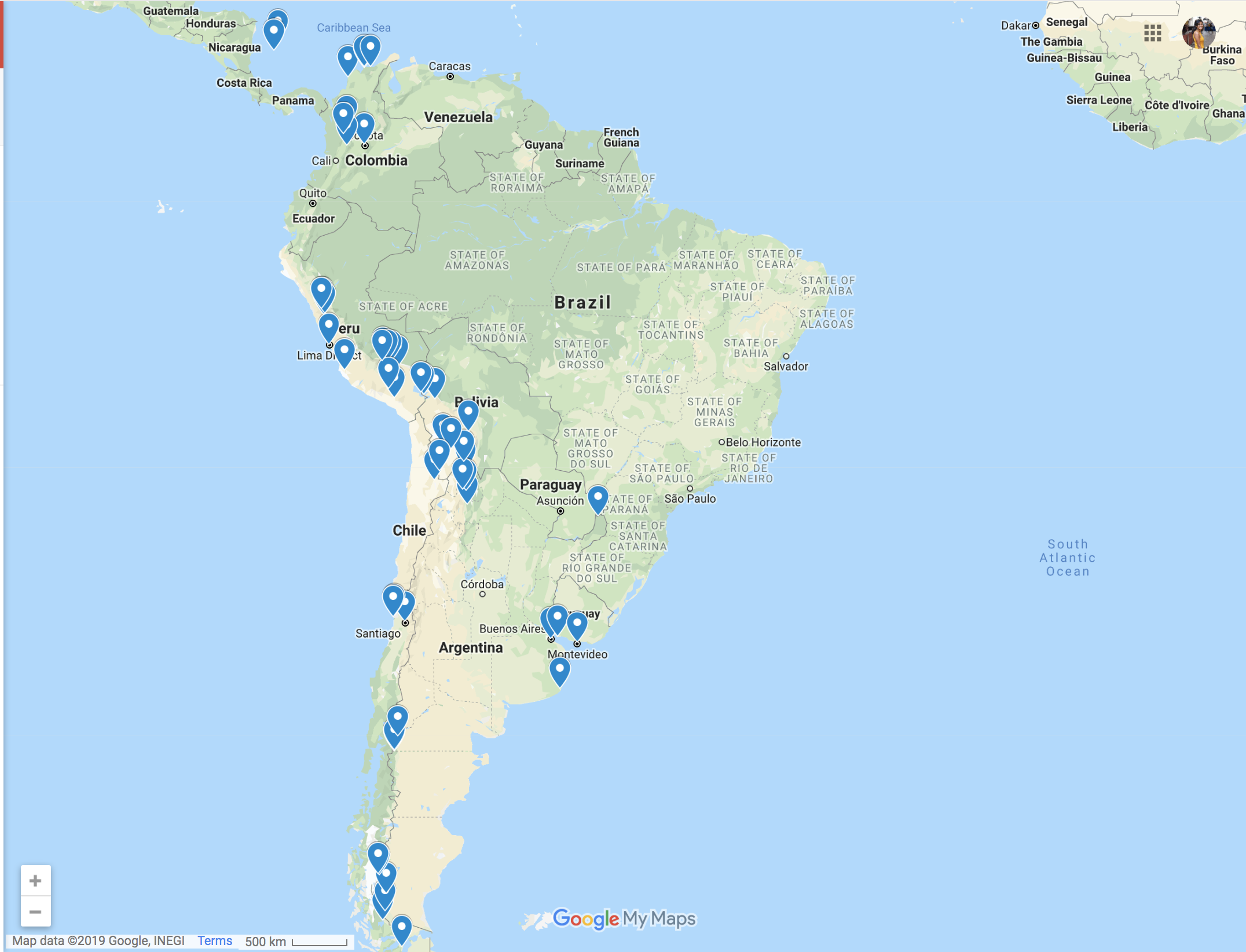
South America travel route
Buenos Aires -> Iguazu Falls -> Salta/Jujuy -> Tupiza -> Sucre -> La Paz -> Copacabana/Lake Titicaca -> La Paz -> Uyuni -> Salt Flats tour -> San Pedro de Atacama -> Lima -> Huaraz (trekking) -> Lima -> Cusco (a lot of trekking) -> Arequipa -> Huacachina -> Lima -> Santiago -> Valparaiso -> Vina del Mar -> Santiago -> Punta Arenas -> Puerto Natales -> Torres del Paine (W-Circuit) -> Puerto Natales -> El Calafate -> El Chalten (a lot of hiking) -> El Hoyo/El Bolson -> Bariloche (Christmas) -> Buenos Aires (long stay) -> Mar del Plata -> Buenos Aires -> Colonia del Sacramento -> Montevideo -> Bogota -> Salento -> Medellin -> Jardin -> Medellin -> San Andres -> Providencia -> Cartagena -> Tayrona National park -> Minca -> Cartagena
South America travel route
Whew! Yep. I totally zig-zagged my way across the continent.💁🏽
I love to have the flexibility of choosing my next destination so I planned very little in advance.
There's no hard and fast rule on what's the best route. If I could do it again, I'd probably start in Colombia and work my way down.
Part of the reason why I chose to avoid a one-way ticket into Colombia is that they're really strict about one-way tickets. On my way from Montevideo to Bogota, I had a stopover in Lima and was denied boarding unless I could show a ticket leaving Colombia. Fortunately, I was able to scramble together a last-minute solution and get on the flight.
Timing Patagonia was on my mind for most of my trip. July and August would have been way too cold and a lot of the hiking trails would have been closed.
I thought about October but after some research, November/December seemed like a better option. No longer the middle of winter and not yet peak summer season where prices double or even triple. So I opted to travel to Peru from San Pedro de Atacama and then head back down to Santiago.
I definitely could have planned a better route according to seasons, but perfection would have just made me procrastinate. Sometimes what seems to be an imperfect mess can create the most perfect and memorable moments. I wouldn't change a thing!
How (not) to pack
I get asked a lot what I'd recommend as a packing list. Part of the reason why I haven't written a packing list blog post is that... Well, I packed terribly! The good news is, I'm proof you can find anything you need on the road and there's no need to stress too much!

Beginning the W-Circuit with a very empty backpack!
My entire backpack weighed 11kg on the way to Buenos Aires. As I bought my winter + hiking gear, it went up to around 14/15kg. I ditched a lot of worn-out clothing and shoes on my way home and my backpack weighed a healthy 10kg coming back to London.
I carried little to no outdoor equipment. I hired tents, hiking poles and sleeping bags relatively cheaply where ever I went which kept my bag light.
If you're planning on camping a lot, especially in Torres del Paine, you might want to think about bringing your own stuff as it can be pricy.
Here are a few things I would have taken which are pretty essential but not a hard and fast list.
Maybe one of these days I'll turn into a pro-camper but for now, I'm still very much a city gal who snails up mountains and overtakes annoyingly slow people on the streets of London at lightning speed.
Hiking boots (good grip and waterproof)
Long thick socks
Thermal top and trousers
Cosy jumper
Hydration bladder
Wooly hat
Gloves
Hiking poles
Mosquito Repellent (I still have scars from the mozzies in Peru!)
Mosquito afterbite cream (the mozzie bites in Peru itch really badly!)
Blister plasters (a foot saver in Patagonia)

Providencia Island
The only time I really needed a swimsuit was in San Andres and Providencia. And I packed 3 of them! 🤦🏽♀️
For my backpack, I used a Berghaus Jalan which I wouldn't recommend because it pretty much fell apart after 6 months and I had to get it restitched a number of times. Although, I like that it was a really good fit for me, opened like a suitcase and held the weight well.
I've heard Osprey is great. But to be honest, when buying a backpack it really depends on the activities you're doing, fabric quality and your own physique. There's no one size fits all.
What I say to my readers who email me is to head to an outdoor store, grab a sales assistant and tell him/her what activities you're doing.
If you're camping and trekking a lot, the backpacks that open from the top can be better for weight distribution. I prefer ones that open like a suitcase because I hate repacking every 3 days.🤷🏽♀️
I'm also quite petite so I had a 60l bag and carrying 15-16kg is generally my limit.
Personally, I would try out different backpacks and walk around the shop with weights inside and see how you feel.
Ask your sales assistant to adjust the straps accordingly. Keep trying until you find one that works for you! The key is to try the backpacks when they're heavy to get a good feel.
I also found the following useful:
Travel towel
Medical kit
Flip flops - useful for after the W-trek! The first thing I did was take my hiking boots off in Paine Grande and take the Catamaran back to Puerto Natales in flip flops. My feet breathed a sigh of relief!
Having a spare padlock for my day bag - useful for night buses when I tried to sleep.
Packing cubes are fab for compressing and saving space.
A spare battery pack to take videos on my phone was great for the Salkantay Trek where charging outlets were scarce.

Mountains in Peru
Useful shops on the road
I went to a store called Himilaya in Cusco, where I picked up rental gear for my hikes and treks in Cusco. For Patagonia, I found a Decathlon in Santiago, Chile! Yay!
Decathlon is a really popular outdoor store in France and after living in Paris for a few years, I knew I would miss this store. Thankfully they've expanded and there's now one in London too!
Money-saving tips and hacks
ATM fees
One of the best travel decisions I made was using a travel-friendly debit card to track my spending and minimise foreign transaction fees. I used Revolut throughout much of South America because it allowed me to track my spending in real time and freeze or unfreeze my card instantly through the app if needed.
My advice to you would be to try your card at a number of different ATMs before you take cash out. The ATM will normally tell you the fee prior to withdrawal. Then pick the one that's free!
In general, I found that:
Paying by card whenever possible saved me a significant amount in fees.
Withdrawal limits varied considerably between countries and banks.
Taking out larger amounts less frequently often worked out cheaper than making lots of small withdrawals.
During my three months in Argentina, avoiding ATM withdrawals altogether saved me a considerable amount of money. Depending on the country, using money transfer services, carrying some backup cash, or paying by card can often be more economical than relying solely on cash machines.
As with all financial advice while travelling, what works best will depend on your country of residence, your bank, and the travel cards available to you.

Sunset in Santiago, Chile
Buses over flights
One of the biggest reasons my budget crept up was because I changed my plans several times along the way. Originally, I had planned to head to Patagonia much earlier. When I decided to switch routes, I took an expensive flight from San Pedro de Atacama to Lima. There's definitely a way to the border of Peru and from Chile with 2-3 buses but I really couldn't find much information on it at the time. The bus definitely would have been much cheaper.
Once I had finished travelling South America, I could have also saved money by going to Pucon, and taking the bus to Santiago after Bariloche as flights from Santiago to Bogota are much cheaper than flying from Buenos Aires or Montevideo.
But I decided to switch routes last minute and head to Buenos Aires for new years. It's an awesome city and I'm so glad I got to experience it in the summer!
So yep... If I were going to do the trip again on a budget, more buses and fewer flights noted for next time. When you opt-out of convenience, it will definitely help to keep your budget down.

Laguna 69, Huaraz
Negotiate accommodation
I found that accommodation prices in South America can sometimes be more flexible than expected.
On a few occasions, I was able to secure better rates by staying longer in one place or speaking directly with hosts. In Bolivia, I even managed to get private rooms for around $5 a night by booking directly at reception rather than through online platforms.
That said, I still regularly used Booking.com throughout my trip. It was especially useful for comparing options, reading reviews, and securing accommodation in advance during busy periods or in places where I arrived late.

Mmmmm...
Cooking instead of eating out
I love cooking with local ingredients but I also love to eat out and trying different cuisines. I would say I got a good balance between the two.
If you're tighter on money, you can definitely cook more. In places like Cusco, it was quite hard to find a hostel with a decent kitchen and looking at my expenses where I splashed out on meals in Peru, I was pretty hungry after my treks.
Pair up with other travellers
When you travel solo, unfortunately, you burden all the costs and that can leave a slightly larger hole in your wallet. Sharing taxis, meal costs and even haggling accommodation in groups can help a lot!
Couch surfing / House sitting / Work Aways
I met a few people who had done this and it's definitely worth looking into! Something to note for next time! I met someone who pretty much house sits her way around Asia and stays in the nicest apartments barely paying anything for accommodation. Ever.

Hammock for the night in Tayrona National park
Staying safe in South America
Safety differs a lot in South America depending on the city. I felt really safe in Sucre, Bolivia and really on edge crossing the Argentina - Bolivia border. The key is to always stay alert and vigilant where ever you are.
As a solo female traveller, if I landed late in a city, which happened a few times after midnight, I would take a private or shared taxi from the airport.
This is definitely more expensive than public transport but midnight in a city I don't know, where public transport is likely to be scarce, I went for the pricier options to get me from the airport to the hostel quickly and smoothly.
You can also ask your host or your hotel for the best ways to get to your accommodation. This helped a lot!

Fitz Roy in El Chalten
Flights to South America
I have a few go-to's for when I'm looking for cheap flights. Given that I flying out to South America in July, peak summer holiday season, getting a ticket as cheap as possible was going to be a challenge.
Skyscanner for comparing airlines and flexible dates.
Trip.com for booking flights and checking multi-city itineraries.
Kiwi.com for finding alternative routes and combinations of airlines.
Booking.com and Agoda, which occasionally have competitive flight deals alongside accommodation options.

My flight to Providencia

Turquoise waters in San Andres
Summary of blog posts in South America
So there we are, my South America travel budget and tips on the road! Hopefully, this is helpful for you. If not, it'll definitely be useful for me to read again one day when I take on South America part 2! 💪
Happy travels!
Ready to plan your trip? Here are some of my favourite travel suggestions.
Booking.com: For the best hotel deals! 🏝
World Nomads: Travel insurance on the go 🌎
Trip.com: A one-stop shop for flights and anything else ✈️
Viator: Experiences across the world 🌟
Car Rentals: Search and compare for your needs 🚗
Airport Taxis: Get there on time 🕰️
Favourite travel items: Some trip planning essentials 🥾
Affiliate links above!
Mandatory Disclaimer: We receive a fee when you get a quote from World Nomads using this link. We do not represent World Nomads. This is not a recommendation to buy travel insurance.
Argentina
Bolivia
Brazil
Chile
Colombia
Peru
Uruguay
Patagonia (Argentina + Chile)
Pin it for later...


